Welcome to Midnight - The Quiet Catalyst
Our platform extracts verified facts from credible news articles and established media outlets to help citizens stay informed. We present information in a neutral, evidence-based manner, allowing readers to form their own conclusions without bias or sensationalism.
Breaking News
More to come.
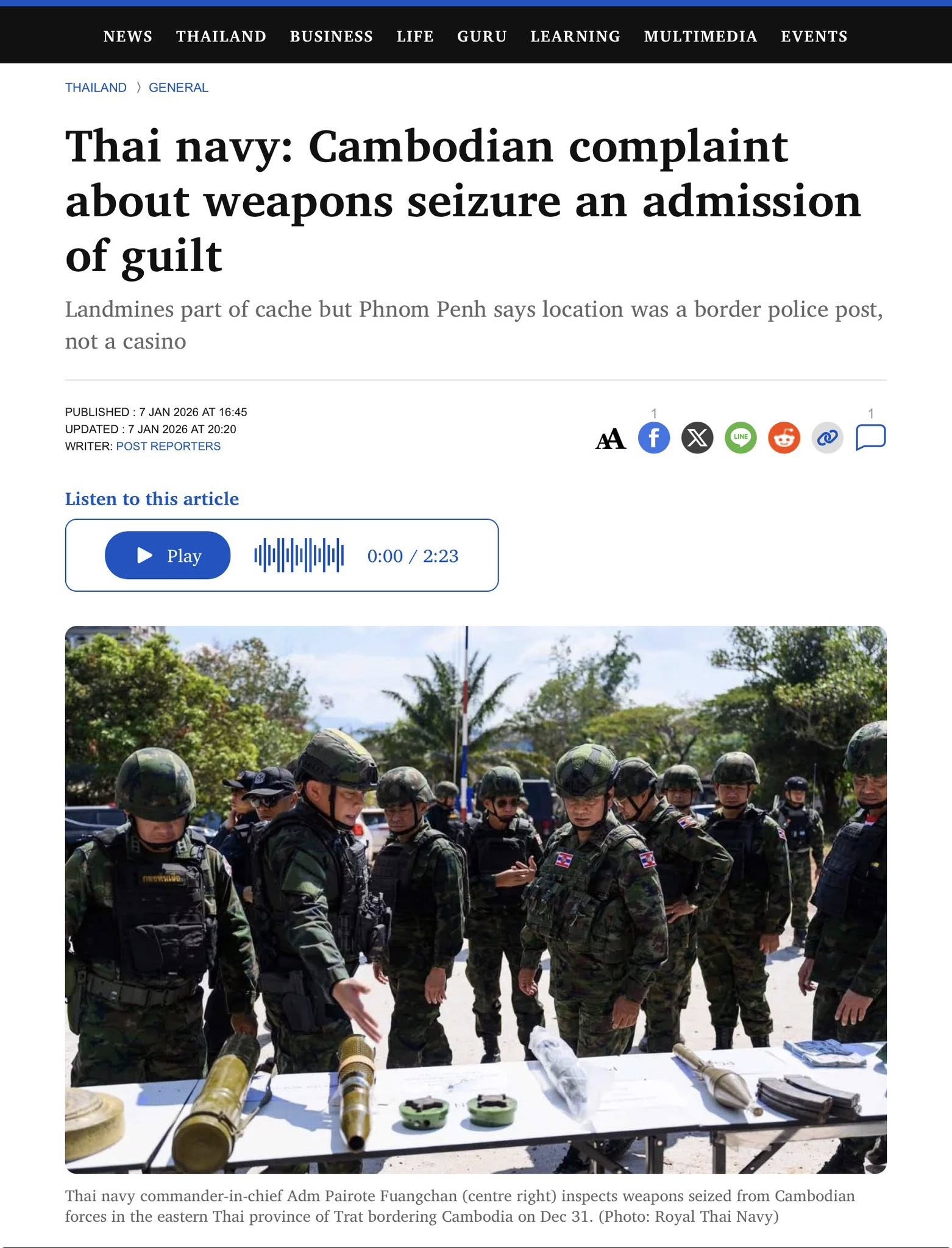
The problem with the Thai navy’s framing is not that it raises questions about weapons or landmines, but that it compresses several unresolved steps into a single moral conclusion. The argument being advanced is essentially this: Cambodia complained that its weapons were “looted,” therefore Cambodia admits the weapons belong to it, therefore Cambodia has admitted to violating the Ottawa Convention. That leap is doing far more work than the evidence can support. A sovereignty dispute over seized property is not, by itself, an admission of treaty breach. At most, it is a claim of ownership or control. Ownership alone does not settle legality. Under the Ottawa Convention, states may retain limited numbers of anti-personnel mines for training and research purposes, and legacy stocks also exist within compliance frameworks. Without clear evidence on the type of devices, their quantity, and whether they exceed permitted categories, the phrase “admission of guilt” reads less like legal reasoning and more like narrative pressure.
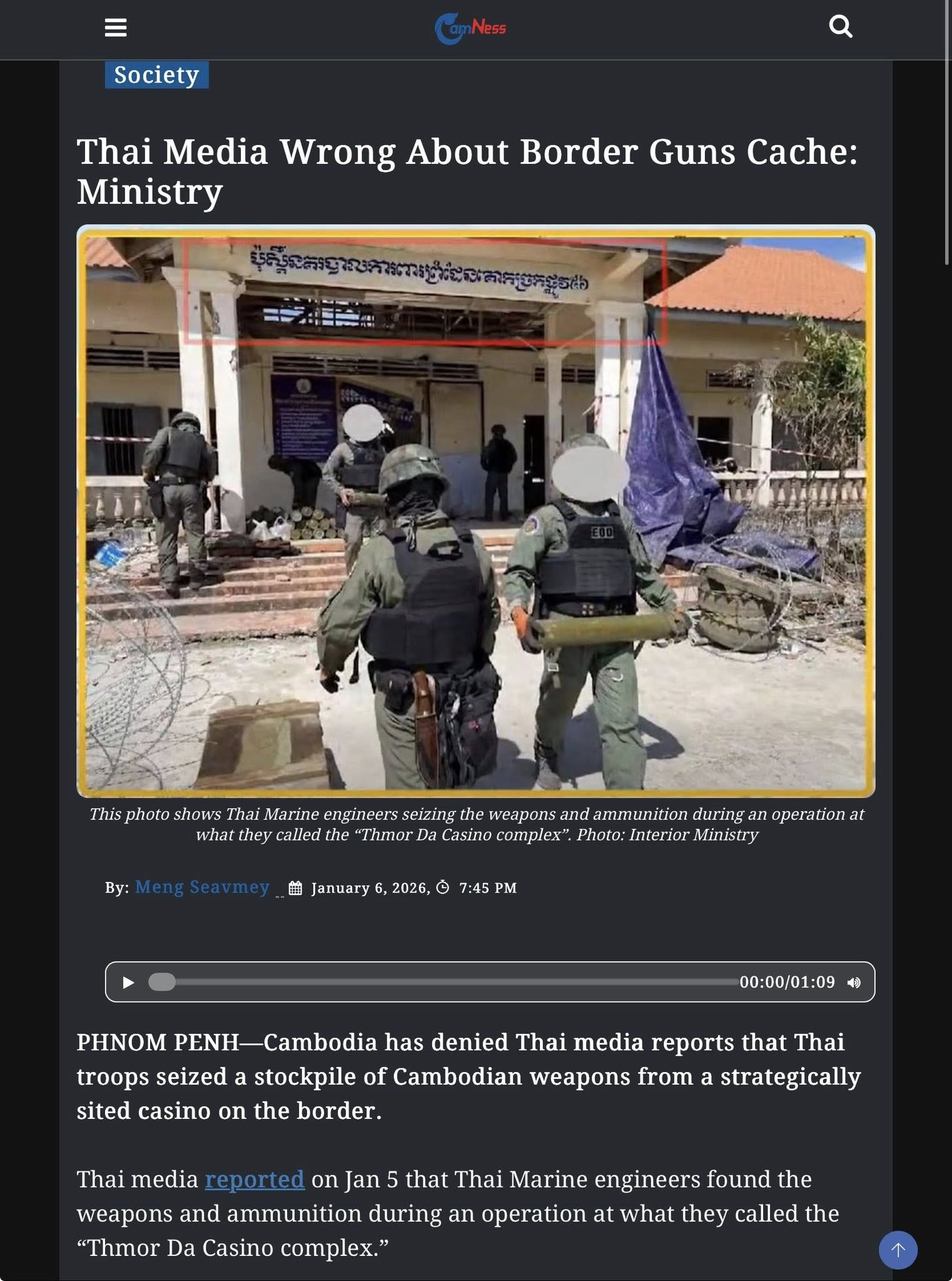
This compression becomes even more fragile when location is introduced, because location is doing most of the argumentative heavy lifting while remaining unresolved. The Thai account insists the cache was found at the Thmor Da casino building, described as being on Thai soil in Trat. Cambodia counters that the images and video released by Thailand show Gate 56 of a Border Patrol Police post in Pursat province, entirely on Cambodian territory. What does not add up is that the entire claim of guilt depends on location and chain-of-custody, yet the article treats the location as effectively settled while simultaneously acknowledging that it is disputed. The ambiguity is not incidental; it sits at the core of the allegation. Wider reporting on the Thmor Da casino itself has long described it as part of a border-adjacent complex tied to Thmor Da commune in Veal Veng district, which is precisely why competing territorial claims can be made in the first place. If the visuals truly come from a police post, Thailand needs to demonstrate how they were geolocated and authenticated. If they truly come from a casino compound on Thai soil, Cambodia must do the same. Until then, assertion is substituting for verification.
The technical description of the weapons further muddies the water. Referring to “anti-personnel mines made from modified anti-tank mines and artillery shells” is not precise enough to sustain an Ottawa Convention conclusion. What matters under the treaty is whether a device qualifies as an anti-personnel mine as defined typically one that is victim-activated by the presence, proximity, or contact of a person. Improvised devices and modified munitions can fall into different legal categories depending on their triggering mechanisms. Some configurations may be command-detonated, which opens an entirely different compliance debate. Without technical identifiers, evidence of triggering systems, and independent assessment, the leap from descriptive language to treaty breach remains premature.
Thailand’s own position within the Ottawa Convention framework further complicates the simplified guilt narrative. This is not a case of a non-party condemning a party. Thailand itself is a State Party, as is Cambodia. Historically, Thailand’s own diplomatic handling of landmine issues has emphasized treaty mechanisms clarification requests, documentation, and compliance procedures rather than instant public verdicts. That matters because it shows that questions of compliance are meant to be addressed through structured processes, not resolved through press statements. By bypassing those procedures, the navy’s argument converts a contested seizure and an unresolved factual record into a moral judgment, collapsing process into posture.
Finally, the way the truce violation is folded into the weapons narrative reveals a reinforcing tactic rather than a clean evidentiary sequence. The structure is telling: first the weapons cache, then the Ottawa Convention accusation, then the mortar incident, followed by a conclusion about Cambodia’s “lack of sincerity.” This bundling encourages the reader to perceive a single, continuous pattern of bad faith, even though each element carries its own verification burden and could plausibly have different explanations. Cambodia’s claim that the mortar incident was accidental is not disproved in the excerpt; it is simply treated as incompatible with sincerity. That is a rhetorical move, not an evidentiary one and it underscores why the overall case feels rhetorically cohesive but analytically unresolved.
Midnight
Sed ut perspiciatis unde
Itaque earum rerum hic tenetur a sapiente delectus, ut aut reiciendis voluptatibus maiores alias consequatur aut perferendis doloribus asperiores Nemo enim ipsam voluptatem quia voluptas sit aspernatur aut odit aut fugit nemo minima rerums unsers sadips amets.






Sed ut perspiciatis unde
Itaque earum rerum hic tenetur a sapiente delectus, ut aut reiciendis voluptatibus maiores alias consequatur aut perferendis doloribus asperiores Nemo enim ipsam voluptatem quia voluptas sit aspernatur aut odit aut fugit nemo minima rerums unsers sadips amets.

Cras eget lacus sed mauris scelerisque tincidunt

Cras eget lacus sed mauris scelerisque tincidunt

Cras eget lacus sed mauris scelerisque tincidunt